

That's Just How I Am: The Sentence People Use to Lock Themselves In
5 min read
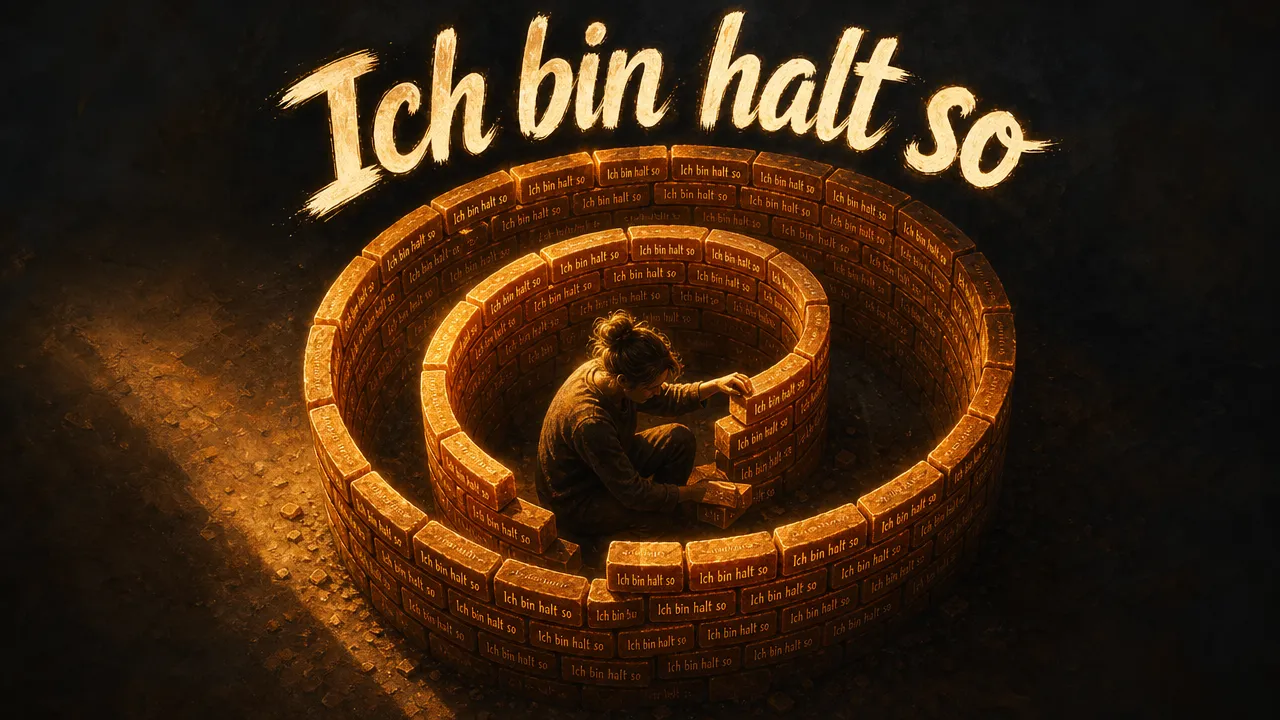
A sentence that sounds like honesty
There are sentences we take to be honest even though they are, in truth, pulling a door shut. “That’s just how I am” is one of them. It sounds like self-knowledge, like healthy acceptance, like “I simply know myself.” But listen more closely to when people say it. Almost always in the moment when something about them is difficult. “I’m just hot-tempered.” “I just can’t approach people.” “I’m just the chaotic type.” The sentence rarely turns up when someone has acted generously or bravely. It comes when something needs defending.
And that is precisely the point. “That’s just how I am” is not a description. It is a defense.
You’re not describing yourself, but an old idea
What we describe with this sentence is never the living being who is sitting there breathing right now. It’s a mental image of ourselves, assembled from memories, other people’s judgments, and stories we’ve told ourselves often enough that they came to feel true. This image is a thought. A stubborn, well-practiced thought, but a thought nonetheless.
The problem isn’t that we have thoughts about ourselves. The problem begins when we confuse ourselves with them. When “I was afraid in this situation” turns into “I am a fearful person,” something movable has been transformed into something fixed. A single moment has hardened into an identity. And identities want to persist. That is their only job.
That’s why “that’s just how I am” feels like protection even though it’s a cage. As long as I claim to be that way, I don’t have to risk anything. I don’t have to approach the person I find attractive. I don’t have to have the conversation I’m afraid of. The sentence spares me the uncertainty of being able to be someone other than the person I’m used to being.
Why we cling to our limitations
It sounds paradoxical, but people often cling precisely to what harms them. Someone who has long defined themselves through a weakness experiences its disappearance as a loss. The shy person who could suddenly speak with ease feels a quiet resistance: if I’m no longer that, who am I then?
This is not a weakness of will. It’s the mechanics of the self-image. Every notion we’ve identified with defends itself the moment it’s called into question. It does so with a simple, effective tool: the sentence “that’s just how I am.” It is the wall behind which the old idea gets to keep living safely.
Think of an argument. Why is it so often so hard to admit you were wrong? Because it feels as though not just an opinion is falling away, but a piece of ourselves. We’re not defending a point, we’re defending an image. And that image senses its own fragility. The very same reflex is at work in “that’s just how I am.” It is the attempt to keep alive a construct that would long since have crumbled without constant repetition.
The world that grows out of this sentence
Whoever is inwardly convinced they are this way and no other will experience precisely the world that confirms that conviction. Not because fate wills it so, but because our conviction determines what we dare to do, what we pay attention to, and how we behave. The man who believes he has no talent for closeness will hold back in relationships. The holding back leads to distance. The distance confirms it: see, that’s just how I am. The sentence creates the very experience that proves it.
This isn’t a punishment. It’s a circle. And circles can be left at any point, the moment you recognize them as circles.
What remains when you drop the sentence
The good news is unspectacular, and therefore easy to overlook. You don’t have to figure out who you “really” are in order to free yourself from the cage. That search would only be the next definition, the next fixed image. It’s enough to leave the sentence unfinished just once. Instead of “I’m just hot-tempered,” a plain “I just felt anger.” Instead of “I can’t do that,” an “I haven’t done that so far.” The difference seems tiny, but it is the whole difference. In the first case you sentence yourself to a trait. In the second you describe a process, and processes are open.
Try it at a single spot. Take a statement you’ve carried around about yourself for years, an “I’m just the type who…” Don’t ask yourself whether it’s true. Ask yourself what you don’t have to do as long as you hold onto it. Most of the time you’ll find there exactly what you’re afraid of, and exactly what would move you forward.
You are not a finished sentence
The consciousness reading these lines right now is not identical with the stories about you. It’s that which can notice the stories in the first place. And whatever can notice stories is never trapped inside them. An image of you can be fixed. You, the one looking at the image, are not.
“That’s just how I am” is, in the end, a claim about something that isn’t fixed at all. You’re not a finished object that can be measured once and then labeled forever. You’re more like an open field, from which something new is allowed to arise in every moment. The sentence that locks you in loses its power the second you notice that you are the one speaking it. And what you speak yourself, you can also leave unspoken.